Protein
How much protein is in ice cream?
A normal scoop from the tub has two to four grams a serve. Anything calling itself high protein ought to be doing considerably better, and the honest ones give you a per serve number instead of hiding behind per 100 g.

The number on the back of most tubs
Standard dairy ice cream lands around 2 to 4 g of protein in a typical serve. Protein isn't what it's built for.
Tubs that print no per serve number usually have a low one. If a number is worth printing, it gets printed.
Why ice cream already has some protein
Milk and cream carry protein on their own. Two kinds: casein, which makes up most of it, and whey. That's why a plain scoop with nothing added still shows two or three grams.
Nobody is adding it. It came with the dairy.
Why there isn't more of it
A litre of ice cream is mostly cream, sugar and air. Those three make up most of it, which leaves relatively little room for protein.
The Australian Food Composition Database puts regular full fat vanilla at 3.7 grams of protein per 100 grams, which is the same source our own pack cites on the back. That's the baseline any high protein claim is measured against, ours included.
To move much past it, a maker has to add protein back as an ingredient, then work to stop it making the texture chalky.
How air changes the number
Overrun is the trade word for how much air gets beaten in. It can double the volume of a mix without adding a gram of anything.
That matters for the label because per 100 g is measured by weight and a serve is usually measured by volume. Whip more air in and a scoop weighs less, so the protein per scoop falls while the protein per 100 g stays exactly where it was.
Two tubs can print the same per 100 g figure and deliver different amounts per serve.
Per serve or per 100 g
Per 100 g makes the number look bigger, because almost nobody eats exactly 100 g of ice cream. It's a comparison unit, not a portion.
Per serve is the number you can act on, once you know what the pack counts as a serve. A large tub can quote a serve size well under what anyone actually takes.
Ours is a 120 mL cup and the whole cup is the serve, so the two numbers are the same thing.
Where protein sits in the ingredients
Ingredients are listed in order of weight, so position tells you roughly how much of something is in there.
Ours reads water, pasteurised cream, sucrose, then milk protein concentrate. Every high protein ice cream uses an added protein of some kind. What differs is where it sits.
Fourth means real dairy and real sugar come before it, rather than the protein powder leading and the dairy trailing behind.
What our label says
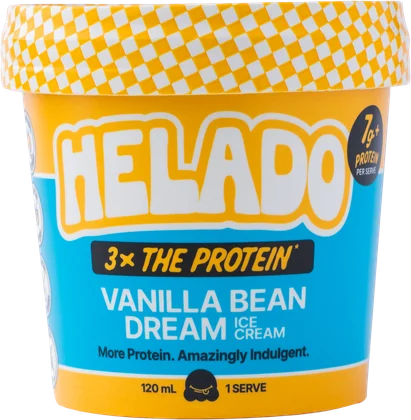
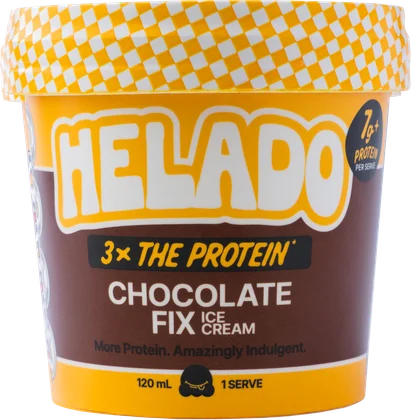
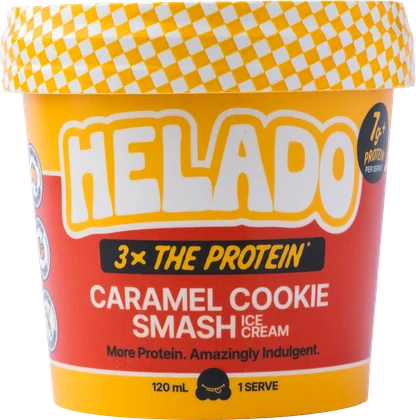
139 calories and 7g+ of protein per cup. Broken out by flavour, because they do differ slightly: Vanilla Bean Dream at 139 cal and 7.4 g, Chocolate Fix at 151 cal and 7.3 g, Caramel Cookie Smash at 139 cal and 7.2 g.
Both numbers, off our own back-of-pack
Chocolate Fix, straight off the panel: the serving size is 65 g and the pack is one serve, so the whole cup is what you eat. That serve carries 632 kJ, which is 151 calories, and 7.3 g of protein. Per 100 g the same tub reads 973 kJ and 11.2 g of protein.
Both protein figures describe the same ice cream. Per 100 g is the larger number because 100 g is more than the 65 g serve. A pack that leads with per 100 g is quoting the flattering one.
What a high number does not tell you
A big number on its own doesn't make something worth eating. Protein can be pushed up by taking dairy out and changing the sugar, and those choices land in the texture and the taste.
The label is only half of it. Taste still decides whether you finish the cup.

Still wondering
Common questions
How much protein is in a normal scoop of ice cream?
Around 2 to 4 g per serve for standard dairy ice cream.
Is high protein ice cream actually ice cream?
Depends on the product. Some are frozen desserts made without real dairy. Helado is made with real dairy, real cream and real sugar.
How much protein is in a Helado cup?
7g+ per 120 mL cup, at 139 calories.


