What to look for
What makes really good ice cream?
Four seconds at the freezer door. That's about how long you get. Door open, cold on your face, someone waiting behind you, eight tubs that look identical from the front. Melbourne is not short of good ice cream. Working out which one you've picked up is the hard part, and it's the name on the back that settles it, not the picture on the front.

What the name on the back has to mean
In Australia, ice cream is a defined food. The name carries a minimum dairy requirement with it. Frozen dessert carries none. The Food Standards Code puts numbers on it. Anything sold as ice cream has to hold at least 100 g of milk fat per kilogram and 168 g of food solids per litre, under Standard 2.5.6. Frozen dessert appears nowhere in the Code at all, which is the whole use of the name.
Removing the dairy is how some very low numbers on the front of a pack get achieved. The calories drop, but the food stops meeting the ice cream standard, so it carries a different name. Both still live in the same freezer.
The front of the pack is where the naming is free. The name of the food, printed on the back near the ingredients, is the regulated one. That is the whole difference between the two sides of a tub.

How much of a tub is air
Every ice cream has air beaten through it while it churns. The trade word is overrun.
Air is the cheapest thing a manufacturer can add, because it fills volume without costing anything. A tub with a lot of it gives you less dairy for the same litre, and you can feel it before you taste it: the spoon goes in too easily and the tub seems to shrink as you eat.
There's no legal ceiling on it either. The word overrun doesn't appear anywhere in the Food Standards Code, and nothing obliges a maker to print how much air is in the tub. Overrun isn't listed on the pack, though weight gives it away: between two tubs of the same volume, the heavier one has less air. Less air also means a slower spoon straight from the freezer.
What real dairy changes
Cream and sugar carry the texture as much as they carry the flavour. Fat coats the tongue and sugar keeps the mix from freezing hard.
Take either one out and something has to stand in. Usually that's more air, or gums and stabilisers doing the job the fat used to do. That's the mouthfeel people describe as thin, or icy, or slightly squeaky against the teeth.
Ours is made in Melbourne from 100% Australian dairy, by a maker who has been doing it since 1970.
Scoop shops are a different question
A scoop from a counter is an outing. You chose the place, you queued, you sat down, and part of what you paid for was the place.
A cup from a freezer door is a decision made standing up, in a few seconds, on the way to something else. Different product, different question, different money.
Most guides to this city cover the first kind. Most ice cream is eaten the second way.
Our numbers, for comparison
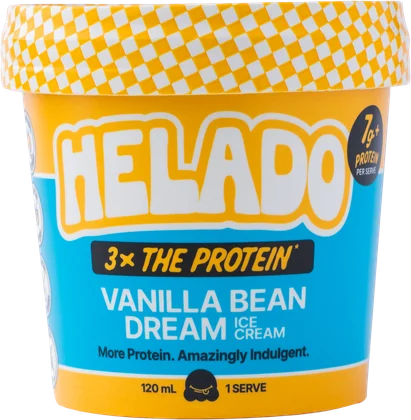
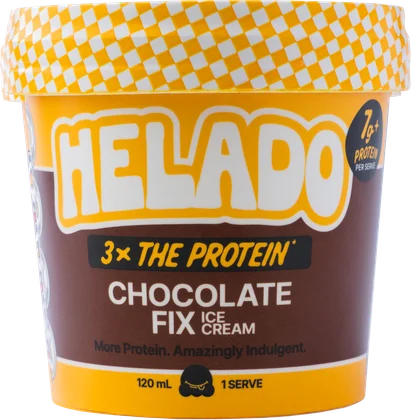
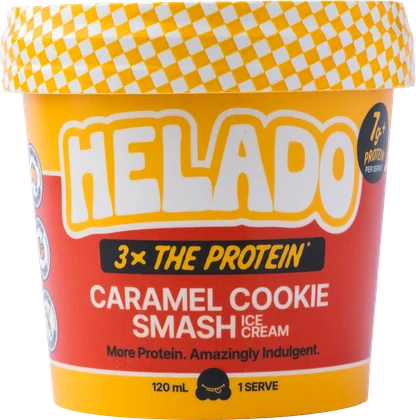
A 120 mL single serve at 139 calories and 7g+ of protein, real dairy, real cream, real sugar. By flavour: Vanilla Bean Dream at 139 cal and 7.4 g, Chocolate Fix at 151 cal and 7.3 g, Caramel Cookie Smash at 139 cal and 7.2 g. The whole cup is the serve, so what's on the front is what you actually eat.
Still wondering
Common questions
What is the difference between ice cream and frozen dessert in Australia?
Ice cream is a defined food with a minimum dairy requirement behind the name. Frozen dessert isn't, which is how it reaches lower calorie and fat numbers. Both sit in the same freezer, with the regulated name of the food on the back.
Why does some ice cream collapse as you eat it?
Air. The more that's whipped in, the more volume you get for less dairy, and the faster it falls apart on the spoon.
Where is Helado made?
In Melbourne, from 100% Australian dairy, by a maker who's been at it since 1970.
How big is a Helado cup?
A 120 mL single serve, and the whole cup is the serve.


